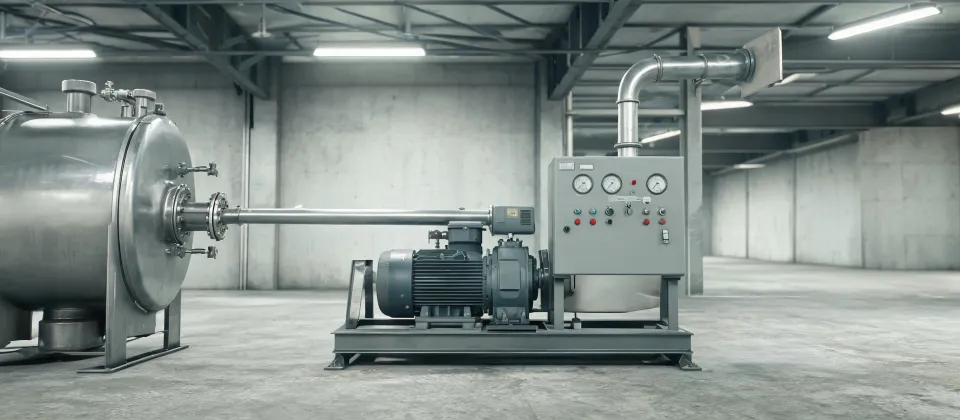
Line interfaces: Sample run
Bring a representative chamber, the intended gas or an agreed mix, and the cycle time that production will later use. Ask the supplier to measure pressure at the chamber, not only at the pump inlet, and to record whether gas ballast was open. A two stage rotary vane vacuum pump may be proposed when the working pressure sits below what a single-stage oil-sealed set can hold with ballast open; that is a selection question, not an automatic upgrade. See working-pressure selection.
Site readiness
List inlet and exhaust flange sizes, three-phase supply, connected load, cooling water if required, footprint, and PLC interface names for run and fault. Upstream valves, filters and downstream exhaust treatment belong in the same drawing. Positive-displacement dry rotary vane compressors sold for pressure service must not be mixed into a vacuum RFQ; keep vacuum and pressure machines on separate briefs. Changeover between products should name gas composition and whether oil or vanes must be inspected before the next SKU.
| Selection factor | Oil-sealed rotary vane | Dry rotary vane |
|---|---|---|
| Working pressure evidence | Ask pumping speed at the working pressure and ultimate pressure with gas ballast open and closed. | Ask pumping speed on a named ACFM or m³/h basis at the working pressure; do not copy oil-sealed Torr figures. |
| Process gas | Oil compatibility, mist exhaust and filter restriction need written answers. | Graphite vane wear, dust and vapor compatibility need written answers. |
| Service boundary | Oil volume in litres, inspection interval and disposal remain buyer or supplier items on the quote. | Vane kit, dust handling and whether SD-style pressure machines are excluded from the vacuum brief. |
| Limitation | Not a substitute for high-vacuum turbomolecular stacks or for unlisted condensable loads. | Not a proof of suitability for wet or contaminated gas solely because oil is absent. |